A bank makes sense the moment one line at one location can no longer clear the queue. A common planning starting point for events is one unit per 75–100 guests for a four-hour window, with more added when alcohol is…
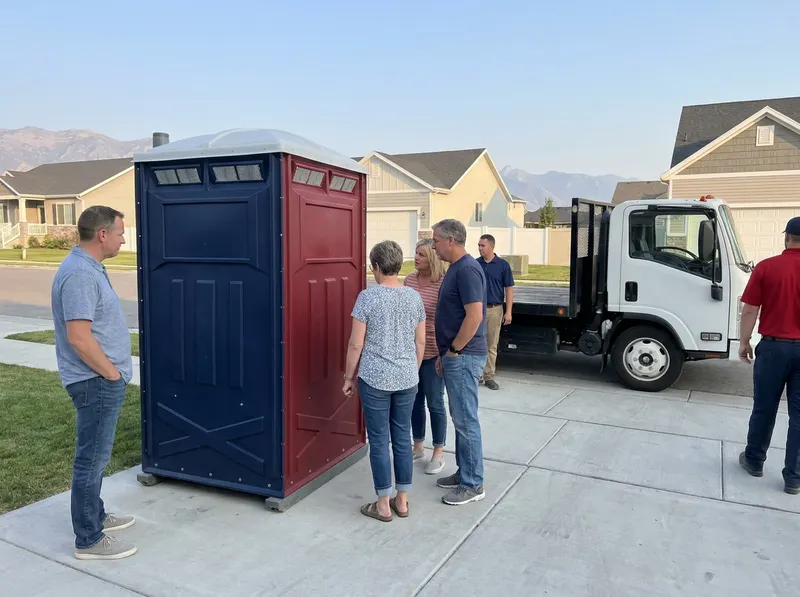
A bank makes sense the moment one line at one location can no longer clear the queue. A common planning starting point for events is one unit per 75–100 guests for a four-hour window, with more added when alcohol is served or the event runs all day — that math is a ballpark, and we tighten it against your gate counts and schedule during the walk-through. Scattered singles look convenient on a site map, but they cost more to service, are harder to keep stocked, and split your signage and lighting. Banks concentrate the traffic, let one service pass cover everything, and give you one place to point people. The trade-off is footprint and sightlines: a 12-unit line needs 60-plus feet of firm ground with a truck lane behind it, so it usually lands at the edge of the field rather than the center of the party.
Placement is where Salt Lake City events actually get won or lost. Liberty Park and Sugar House Park banks generally set on pathway edges or firm turf shoulders so the service truck never crosses soft irrigated grass — spring events on those lawns can be genuinely wet, and a loaded truck leaves ruts that the parks people remember. The Utah State Fairpark in the Fairpark neighborhood offers asphalt and gravel that make winter and shoulder-season sets easier. Street-adjacent events near Vivint Arena, the Ballpark area, and downtown blocks around Temple Square often require the bank to sit tight against a curb line or inside a fenced footprint, which changes the layout from one long row to two short banks. Trail-based events along the Jordan River Parkway Trail through Rose Park, Poplar Grove, and Glendale need bollard clearance and a marked access point noted on the order before delivery day. Hillside and narrow-street venues in The Avenues, Capitol Hill, the Marmalade District, and up near the Utah State Capitol usually mean a smaller truck, a shorter bank, and a confirmed turnaround spot.
Salt Lake weather shapes the spec. Canyon-mouth wind and afternoon gusts off the valley floor mean units at exposed sites get staked or ballasted rather than free-standing. July and August heat in the valley makes service frequency, not unit count, the thing guests notice — multi-day festivals in Liberty Wells, Yalecrest, East Central, and Salt Lake County venues generally get a scheduled overnight or early-morning pass with pump, restock, and wipe-down. For events with a public accessibility requirement, ADA-accessible units are set on level ground with an approach path, usually at the end of the bank nearest the main route. Reserved crew or talent units are a common add for film shoots and staged festivals and are simply placed and signed separately.
We put quantities, delivery window, service cadence, and placement in writing before the truck rolls, because guessing at those is how events end up with a full unit on day two and a super or planner fielding complaints all weekend. Bring us a site map or a rough sketch and we will mark the bank, the truck lane, and the pickup window on it. Clean units, exact spot, on schedule.
Every job gets a firm, written price after a free on-site visit.
Tell us about your festival & large-event unit banks job in Salt Lake City and we'll send a clear, written quote — usually the same day.
 CleanVertex Porta Potty Solutions