An ADA unit is the right call any time the public, wedding guests, or a mixed-ability crew will use the restroom. The 2010 ADA Standards are commonly read to require that where single-user portable toilets are…
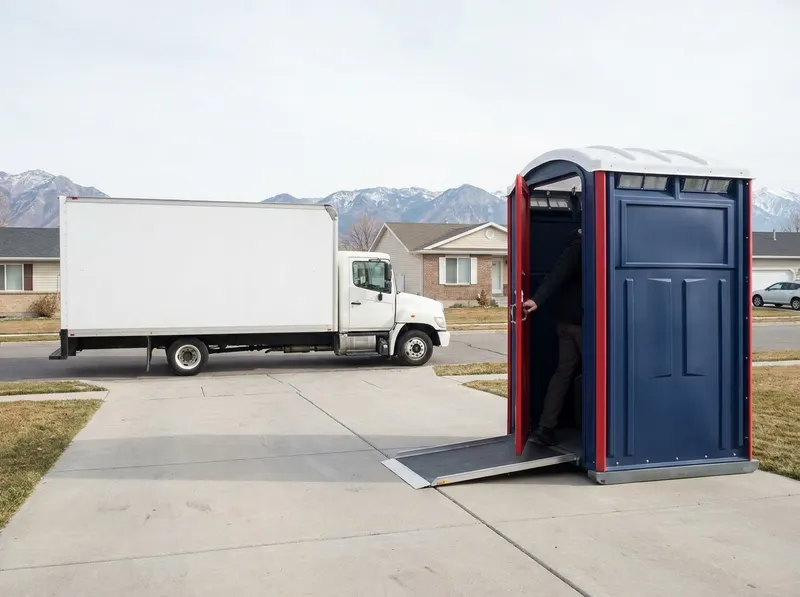
An ADA unit is the right call any time the public, wedding guests, or a mixed-ability crew will use the restroom. The 2010 ADA Standards are commonly read to require that where single-user portable toilets are clustered at one location, at least one accessible unit be provided in the cluster, and Salt Lake City event organizers applying for park or street-use permits are often asked to state how many accessible facilities they've arranged. If your entire guest list is a five-person framing crew on a private lot, a standard unit is usually enough. If you're putting up chairs at Liberty Park, running a fundraiser walk off the Jordan River Parkway Trail, or hosting a reception in a Yalecrest backyard where grandparents are attending, plan the accessible unit in from the start rather than adding it two days out.
The trade-off is footprint and ground. An ADA unit occupies roughly a 5.5-foot square instead of the standard 4-foot box, and it only works if it sits level and firm with a clear approach. That matters in specific Salt Lake neighborhoods. The stepped terraces and steep cross-slopes in The Avenues and Capitol Hill often mean the only viable spot is the flat apron near the driveway, not the back corner of the yard. Older Liberty Wells and East Central lots have narrow park strips and mature street trees that eat the setback. Turf and gravel paths at Sugar House Park and Fairpark events can leave a wheelchair short of the door unless the unit is staged on a compacted path or a mat. We'd rather walk the site with you and mark a spot that actually works than drop a unit somewhere a wheelchair can't reach it.
Placement and service reliability are the two things that fail in this trade, so we make both visible. Every ADA order gets a written confirmation with quantity, dates, the marked location, and the service day. Drivers send arrival and service notifications, and the accessible unit is on the same route as your standard units — no separate schedule to get skipped. For long job-site terms in Rose Park, Glendale, or Poplar Grove where an ADA unit serves inspectors and public foot traffic, weekly service is the normal baseline and twice-weekly is available when headcount or heat pushes it. Winter changes the plan: freeze-resistant tank treatment, snow-clear access to the door, and a placement chosen so a plow or shoveled berm doesn't wall off the ramp lip.
We also spec by use case rather than guessing. Tell us headcount, hours, whether alcohol is served, and how many hours the site is open, and we'll tell you how many total units plus how many accessible ones the layout should carry, along with the truck access we need — roughly 12 feet of width and 12 feet of overhead clearance to reach the spot. Airport-area contracts, University of Utah campus-adjacent projects, and canyon-access sites all get the same treatment: exact spot, confirmed in writing, serviced on schedule.
Every job gets a firm, written price after a free on-site visit.
Tell us about your ada-accessible portable toilet rental job in Salt Lake City and we'll send a clear, written quote — usually the same day.
 CleanVertex Porta Potty Solutions